Not like the
while
loop tests the loop condition in the loop header, inthe Scala language
do...while
a loop checks its condition at the end of the loop.
In Scala language the Notice that the conditional expression appears at the end of the loop, so the If the condition is the This process is repeated over and over again until a given condition becomes``false`` so far. The output result of executing the above code is:
do...while
cycle and the
while
loop is similar, but the
do...while
loop ensures that the loop is executed at least once. 8.12.1. Grammar #
while
syntax of the loop:do {
statement(s);
} while( condition );
8.12.2. Flow chart #
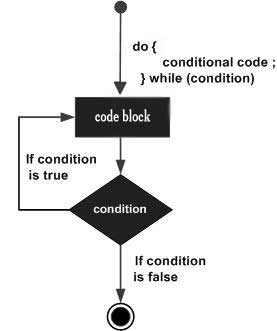
statement(s)
will be executed at least once before the conditionis tested.
true
control flow will jump back to the above
do
and then re-execute the
statement(s)
. 8.12.3. Example #
Example #
object Test {
   def main(args: Array[String]) {
      // local variable
      var a = 10;
      // do loop
      do{
         println( "Value of a: " + a );
         a = a + 1;
      }while( a < 20 )
   }
}
$ scalac Test.scala
$ scala Test
value of a: 10
value of a: 11
value of a: 12
value of a: 13
value of a: 14
value of a: 15
value of a: 16
value of a: 17
value of a: 18
value of a: 19