In many practical problems, there are many regular repetitive operations, soit is necessary to repeat some statements in the program.
The following is a flowchart of looping programs in most programming languages:
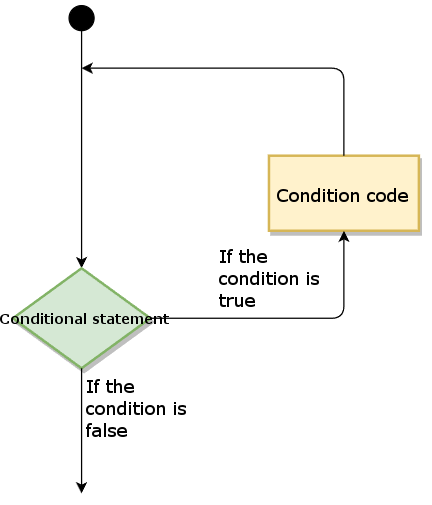
Go
language provides the following types of loop processing statements:
Cycle type | Description |
|---|---|
Break statement | Repetitive execution statement block |
Continue statement | Nesting one or more for loops within for loops |
2.23.1. Loop control statement #
Loop control statements can control the execution of statements in the loop.
GO
language supports the following loop control statements:
Control statement | Description |
|---|---|
Break statement | Often used to break the current for loop or jump out of switch statements |
Continue statement | Skip the remaining statements of the current loop and proceed to the next loop. |
Goto statement | Transfer control to the marked statement. |
2.23.2. Infinite cycle #
If the conditional statement in the loop is never
false
, there will be an infinite loop, and we can pass through
for
only one conditional expression is set in the loop statement to execute the infinite loop:Example #
package main
import "fmt"
func main() {
    for true  {
        fmt.Printf("This is an infinite loop.\\n");
    }
}