Perl The syntax format is as follows: If a Boolean expression Execute the above program, and the output is as follows:
if
statement consists of a Boolean expression followed by one or more statements. 5.11.1. Grammar #
if(boolean_expression){
   # In the Boolean expression boolean_ Execute when expression is true
}
boolean_expression
for
true
, then
if
the block of code within the statement will be executed. If the Boolean expression is
false
, then
if
the first set of code at theend of the statement (after closing parentheses) is executed. 5.11.2. Flow chart #
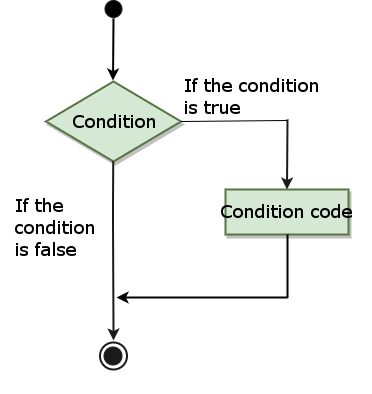
Example #
#/ Usr/bin/perl $a=10# Use the if statement to determine the Boolean expression if ($a<20){#
When the Boolean expression is true, execute printf "a is less than 20 n";} The value of print 'a' is
: $a n "; $a=" "; # Use the if statement to determine the Boolean expression if ($a){#
Execute printf when the Boolean expression is true "variable a is true n";} The value of print 'a' is
: $a n ";
A less than 20
The value of a is: 10
The value of a is: