The Django Form component is used to initialize the page, generate HTML tags, and validate the data submitted by the user (displaying error messages).
报错信息显示顺序:
Displays the error message in the field properties before displaying the error message for the local hook.
If the error message for the field property is displayed, the error message for the local hook is not displayed.
If there is a global hook, the global hook will not be verified until all the data has been verified, and the error message of the global hook must be displayed.
To use the Form component, you need to import forms first:
from django import forms
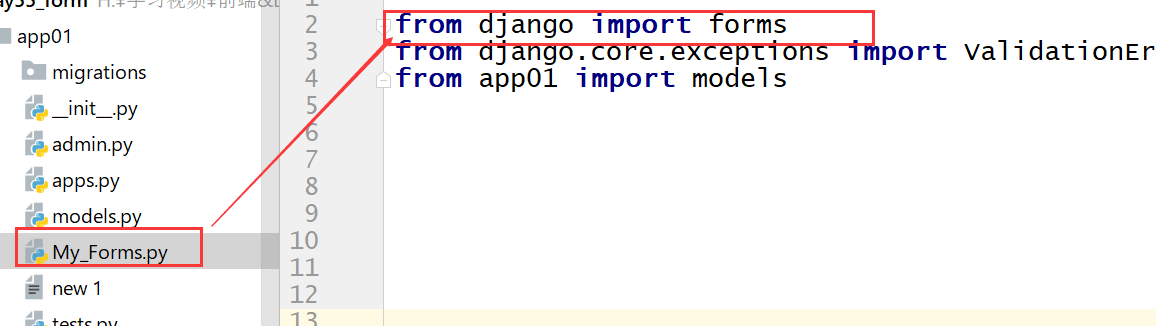
Next, we create a My_forms.py under the app01 directory: 字段属性: label Enter the text information in front of the box error_message Customizes the error message displayed, and the attribute value is the dictionary, where required is the key that sets the error message that cannot be empty. Add the following rules to the app01/urls.py file: HTML template: The running result is shown in the following figure: Define the Form class: Views.py file code: The template file code is as follows: The running result is shown in the following figure: https://www.runoob.com/wp-content/uploads/2020/05/1563239932711.png 7.14.1. app01/My_forms.py 
from django import forms
from django.core.exceptions import ValidationError
from app01 import models
class EmpForm(forms.Form):
    name = forms.CharField(min_length=4, label="姓名",
error_messages={"min_length": "你太短了", "required":
"该字段不能为空!"})
    age = forms.IntegerField(label="年龄")
    salary = forms.DecimalField(label="工资")
7.14.2. app01/views.py 
from django.shortcuts import render, HttpResponse
from app01.My_Forms import EmpForm
from app01 import models
from django.core.exceptions import ValidationError
# Create your views here.
def add_emp(request):
    if request.method == "GET":
        form = EmpForm()
        return render(request, "add_emp.html", {"form": form})
    else:
        form = EmpForm(request.POST)
        if form.is_valid():  # 进行数据校验
            # 校验成功
            data = form.cleaned_data  #
校验成功的值,会放在cleaned_data里。
            data.pop('r_salary')
            print(data)
            models.Emp.objects.create(\**data)
            return HttpResponse(
                'ok'
            )
            # return render(request, "add_emp.html", {"form": form})
        else:
            print(form.errors)    # 打印错误信息
            clean_errors = form.errors.get("__all__")
            print(222, clean_errors)
        return render(request, "add_emp.html", {"form": form,
"clean_errors": clean_errors})
path('add_emp/', views.add_emp)
7.14.3. app01/add_emp.html 
<!DOCTYPEhtml><htmllang="en"><head><metacharset="UTF-8"><title></title></head><body><h3>添加员工</h3>{#1、自己手动写HTML页面#}<formaction=""method="post"><p>姓名:<inputtype="text"name="name"></p><p>年龄:<inputtype="text"name="age"></p><p>工资:<inputtype="text"name="salary"></p><inputtype="submit"></form>{#2、通过form对象的as_p方法实现#}
{#<formaction=""method="post"novalidate>#} {# {% csrf_token %}#} {# {{
form.as_p }}#} {#<inputtype="submit">#} {#</form>#}
{#3、手动获取form对象的字段#} {#<formaction=""method="post"novalidate>#}
{# {% csrf_token %}#} {#<div>#} {#<labelfor="id_{{ form.name.name
}}">姓名</label>#} {# {{ form.name }}<span>{{ form.name.errors.0
}}</span>#} {#</div>#} {#<div>#} {#<labelfor="id_{{ form.age.name
}}">年龄</label>#} {# {{ form.age }}<span>{{ form.age.errors.0
}}</span>#} {#</div>#} {#<div>#} {#<labelfor="id_salary">工资</label>#}
{# {{ form.salary }}<span>{{ form.salary.errors.0 }}</span>#} {#</div>#}
{#<inputtype="submit">#} {#</form>#} {#4、用for循环展示所有字段#}
{#<formaction=""method="post"novalidate>#} {# {% csrf_token %}#} {# {%
for field in form %}#} {#<div>#} {#<labelfor="id_{{ field.name }}">{{
field.label }}</label>#} {# {{ field }}<span>{{ field.errors.0
}}</span>#} {#</div>#} {# {% endfor %}#} {#<inputtype="submit">#}
{#</form>#}</body></html>

Local hooks and global hooks 
7.14.4. app01/My_forms.py 
from django import forms
from django.core.exceptions import ValidationError
from app01 import models
class EmpForm(forms.Form):
    name = forms.CharField(min_length=5, label="姓名",
error_messages={"required": "该字段不能为空!",

 "min_length": "用户名太短。"})
    age = forms.IntegerField(label="年龄")
    salary = forms.DecimalField(max_digits=5, decimal_places=2,
label="工资")
    r_salary = forms.DecimalField(max_digits=5, decimal_places=2,
label="请再输入工资")
    def clean_name(self):  # 局部钩子
        val = self.cleaned_data.get("name")
        if val.isdigit():
            raise ValidationError("用户名不能是纯数字")
        elif models.Emp.objects.filter(name=val):
            raise ValidationError("用户名已存在!")
        else:
            return val
    def clean(self):  # 全局钩子 确认两次输入的工资是否一致。
        val = self.cleaned_data.get("salary")
        r_val = self.cleaned_data.get("r_salary")
        if val == r_val:
            return self.cleaned_data
        else:
            raise ValidationError("请确认工资是否一致。")
7.14.5. app01/views.py 
def add_emp(request):
    if request.method == "GET":
        form = EmpForm()  # 初始化form对象
        return render(request, "add_emp.html", {"form":form})
    else:
        form = EmpForm(request.POST)  # 将数据传给form对象
        if form.is_valid():  # 进行校验
            data = form.cleaned_data
            data.pop("r_salary")
            models.Emp.objects.create(\**data)
            return redirect("/index/")
        else:  # 校验失败
            clear_errors = form.errors.get("__all__")  #
获取全局钩子错误信息
            return render(request, "add_emp.html", {"form": form,
"clear_errors": clear_errors})
7.14.6. app01/add_emp.html 
<formaction=""method="post"novalidate>{% csrf_token
%}<div><labelfor="id_{{ form.name.name }}">姓名</label>{{ form.name
}}<span>{{ form.name.errors.0 }}</span></div><div><labelfor="id_{{
form.age.name }}">年龄</label>{{ form.age }}<span>{{ form.age.errors.0
}}</span></div><div><labelfor="id_salary">工资</label>{{ form.salary
}}<span>{{ form.salary.errors.0 }}{{ clear_errors.0
}}</span></div><div><labelfor="id_r_salary">请再输入工资</label>{{
form.r_salary }}<span>{{ form.r_salary.errors.0 }}{{ clear_errors.0
}}</span></div><inputtype="submit"></form>

