3.24.1. Slice 
There is another kind of cluster in Mongodb, that is, sharding technology, which can meet the needs of the massive growth of MongoDB data.
When MongoDB stores large amounts of data, one machine may not be enough to store data, or it may not be enough to provide acceptable read and write throughput. At this time, we can split the data on multiple machines, so that the database system can store and process more data.
3.24.2. Why do you use fragmentation? 
Copy all writes to the primary node
Delay-sensitive data will be queried at the primary node
A single replica set is limited to 12 nodes
Running out of memory occurs when the number of requests is large.
Insufficient local disk
Vertical expansion is expensive
3.24.3. MongoDB fragmentation 
The following figure shows the distribution using the sharding cluster structure in MongoDB:
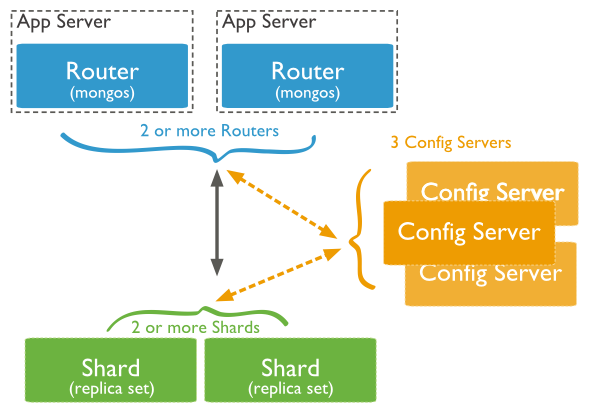
There are three main components in the above figure as follows:
Shard: It is used to store actual data blocks. In the actual production environment, a shard server role can be assumed by several machines grouped into a replica set to prevent a single point of failure of the host.
Config Server: Mongod instance, which stores the entire ClusterMetadata, including chunk information.
Query Routers: The front-end routing allows the client to access, and makes the whole cluster look like a single database, and the front-end applications can be used transparently.
3.24.4. Sharding instance 
The port distribution of the sharding structure is as follows:
Shard Server 1:27020
Shard Server 2:27021
Shard Server 3:27022
Shard Server 4:27023
Config Server :27100
Route Process:40000
Step 1: start Shard Server
[root@100 /]# mkdir -p /www/mongoDB/shard/s0
[root@100 /]# mkdir -p /www/mongoDB/shard/s1
[root@100 /]# mkdir -p /www/mongoDB/shard/s2
[root@100 /]# mkdir -p /www/mongoDB/shard/s3
[root@100 /]# mkdir -p /www/mongoDB/shard/log
[root@100 /]# /usr/local/mongoDB/bin/mongod --port 27020 --dbpath=/www/mongoDB/shard/s0 --logpath=/www/mongoDB/shard/log/s0.log --logappend --fork
....
[root@100 /]# /usr/local/mongoDB/bin/mongod --port 27023 --dbpath=/www/mongoDB/shard/s3 --logpath=/www/mongoDB/shard/log/s3.log --logappend --fork
Step 2: start Config Server
[root@100 /]# mkdir -p /www/mongoDB/shard/config
[root@100 /]# /usr/local/mongoDB/bin/mongod --port 27100 --dbpath=/www/mongoDB/shard/config --logpath=/www/mongoDB/shard/log/config.log --logappend --fork
注意: Here we can start like a normal mongodb service without adding the-shardsvr and configsvr parameters. Because the function of these two parameters is to change the startup port, we can specify the port ourselves.
Step 3: start Route Process
/usr/local/mongoDB/bin/mongos --port 40000 --configdb localhost:27100 --fork --logpath=/www/mongoDB/shard/log/route.log --chunkSize 500
Among the mongos startup parameters, chunkSize is used to specify the size of the chunk (in MB). The default size is 200MB.
Step 4: configure Sharding
Next, we use MongoDB Shell to log in to mongos and add the Shard node
[root@100 shard]# /usr/local/mongoDB/bin/mongo admin --port 40000
MongoDB shell version: 2.0.7
connecting to: 127.0.0.1:40000/admin
mongos> db.runCommand({ addshard:"localhost:27020" })
{ "shardAdded" : "shard0000", "ok" : 1 }
......
mongos> db.runCommand({ addshard:"localhost:27029" })
{ "shardAdded" : "shard0009", "ok" : 1 }
mongos> db.runCommand({ enablesharding:"test" }) #设置分片存储的数据库
{ "ok" : 1 }
mongos> db.runCommand({ shardcollection: "test.log", key: { id:1,time:1}})
{ "collectionsharded" : "test.log", "ok" : 1 }
Step 5: connect the database to interface 40000 without much change in the program code, just like connecting to an ordinary mongo database.