First, define a binary search tree. The Java code is as follows:
public class BST<Key extends Comparable<Key>, Value> {
    // 树中的节点为私有的类, 外界不需要了解二分搜索树节点的具体实现
    private class Node {
        private Key key;
        private Value value;
        private Node left, right;
        public Node(Key key, Value value) {
            this.key = key;
            this.value = value;
            left = right = null;
        }
    }
    // 根节点
    private Node root;
    // 树种的节点个数
    private int count;
    // 构造函数, 默认构造一棵空二分搜索树
    public BST() {
        root = null;
        count = 0;
    }
    // 返回二分搜索树的节点个数
    public int size() {
        return count;
    }
    // 返回二分搜索树是否为空
    public boolean isEmpty() {
        return count == 0;
    }
}
Node represents nodes and count represents the number of nodes.
The following example inserts element 61 into the following binary search tree:

(1)需要插入的元素 61 比 42 大,比较 42 的右子树根节点。

(2)61 比 59 大,所以需要把 61 移动到 59 右子树相应位置,而此时为空,直接插入作为 59 的右子节点。
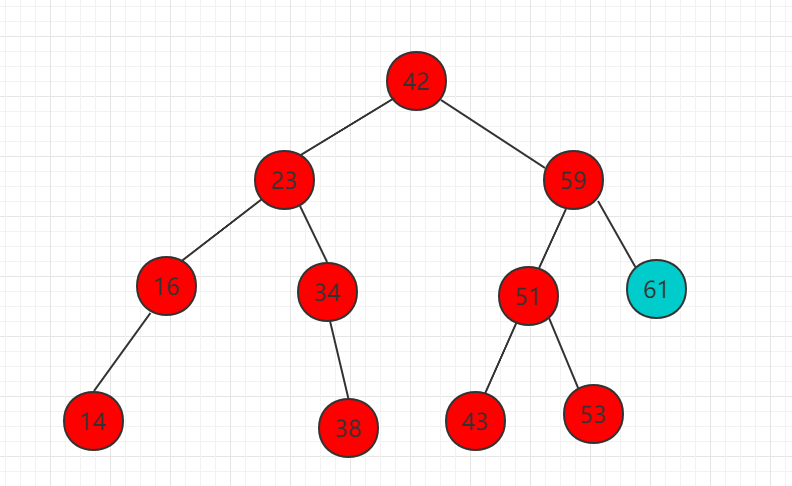
The insert operation is also a recursive process, which is divided into three cases, equal to, greater than, and less than. 源码包下载: Download 5.16.1. Java instance code 
Src/runoob/binary/BinarySearchTreeInsert.java file code: 
package runoob.binary;
/*\*
 \* 二分搜索树插入新的元素
 */
public class BinarySearchTreeInsert<Key extends Comparable<Key>, Value>
{
    // 树中的节点为私有的类, 外界不需要了解二分搜索树节点的具体实现
    private class Node {
        private Key key;
        private Value value;
        private Node left, right;
        public Node(Key key, Value value) {
            this.key = key;
            this.value = value;
            left = right = null;
        }
    }
    private Node root;  // 根节点
    private int count;  // 树种的节点个数
    // 构造函数, 默认构造一棵空二分搜索树
    public BinarySearchTreeInsert() {
        root = null;
        count = 0;
    }
    // 返回二分搜索树的节点个数
    public int size() {
        return count;
    }
    // 返回二分搜索树是否为空
    public boolean isEmpty() {
        return count == 0;
    }
    // 向二分搜索树中插入一个新的(key, value)数据对
    public void insert(Key key, Value value) {
        root = insert(root, key, value);
    }
    //核心代码---开始
    // 向以node为根的二分搜索树中, 插入节点(key, value), 使用递归算法
    // 返回插入新节点后的二分搜索树的根
    private Node insert(Node node, Key key, Value value) {
        if (node == null) {
            count++;
            return new Node(key, value);
        }
        if (key.compareTo(node.key) == 0)
            node.value = value;
        else if (key.compareTo(node.key) < 0)
            node.left = insert(node.left, key, value);
        else    // key > node->key
            node.right = insert(node.right, key, value);
        return node;
    }
    //核心代码---结束
}