9.33.1. Brief introduction 
We can use the email application in the IOS device to send e-mail.
9.33.2. Instance step 
1、创建一个简单的View based application
2、选择项目文件,然后选择目标,然后添加MessageUI.framework
3、在ViewController.xib中添加一个按钮,创建用于发送电子邮件的操作(action)
4、更新ViewController.h,如下所示
#import <UIKit/UIKit.h>
#import <MessageUI/MessageUI.h>

@interface ViewController : UIViewController<MFMailComposeViewControllerDelegate>
{
    MFMailComposeViewController *mailComposer;
}

-(IBAction)sendMail:(id)sender;

@end
5、如下所示,更新ViewController.m
#import "ViewController.h"

@interface ViewController ()

@end

@implementation ViewController

- (void)viewDidLoad
{
    [super viewDidLoad];
}

- (void)didReceiveMemoryWarning
{
    [super didReceiveMemoryWarning];
    // Dispose of any resources that can be recreated.
}

-(void)sendMail:(id)sender{
    mailComposer = [[MFMailComposeViewController alloc]init];
    mailComposer.mailComposeDelegate = self;
    [mailComposer setSubject:@"Test mail"];
    [mailComposer setMessageBody:@"Testing message
    for the test mail" isHTML:NO];
    [self presentModalViewController:mailComposer animated:YES];
}

#pragma mark - mail compose delegate
-(void)mailComposeController:(MFMailComposeViewController *)controller
 didFinishWithResult:(MFMailComposeResult)result error:(NSError *)error{
   if (result) {
        NSLog(@"Result : %d",result);
    }
    if (error) {
        NSLog(@"Error : %@",error);
    }
    [self dismissModalViewControllerAnimated:YES];

}

@end
9.33.3. Output 
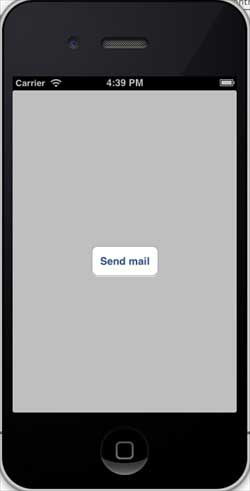
When you run the application, you will see the following output
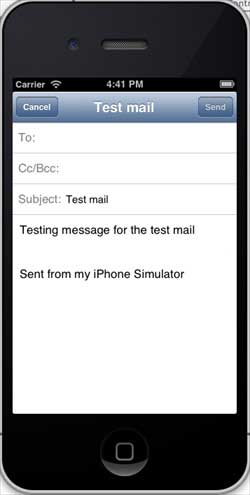
When you click the “send email” send button, you can see the following results: